
Por Jim Glade
August 27, 2026
An industrial machine can begin to show signs of wear long before it stops working. The challenge for companies isn't necessarily detecting that something is wrong, but doing so in a timely manner without exposing workers to running equipment and without relying on manual inspections every few weeks.
That was the problem identified by Dynamox, a startup founded in Florianópolis that began by developing wireless vibration sensors for predictive maintenance. Over time, the company expanded its focus to a platform that combines hardware, software, data, and artificial intelligence.
The market is also keeping pace with this transition. Grand View Research estimates that the predictive maintenance market in Latin America was worth approximately US$1.5 billion in 2025 and could reach $11.2 billion by 2033, with a compound annual growth rate of 29.4% between 2026 and 2033.
Dynamox began operations in 2016 and launched its first generation of wireless vibration sensors in 2018. According to Bernardo Pereira Murta, the company's Principal Engineer, the technology was developed to solve a problem that went beyond simply making maintenance more efficient: reducing the risk workers face when checking the condition of operating machinery.
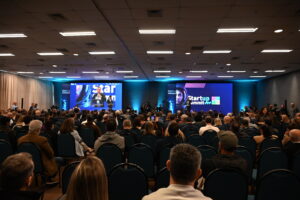
"Wired sensors involve significant exposure and life-threatening risks, because people have to get close to equipment that's running to check for problems," Murta explained in an interview with Contxto during the Startup Summit 2026.
A year later, the company incorporated data collectors and a web platform to scale up monitoring. Instead of conducting inspections every 15 or 30 days, industrial teams could begin receiving continuous data from their assets.
This evolution led Dynamox to expand its product lineup beyond vibration and temperature. Today, the company also works with thermography, current, and voltage sensors, with its platform processing approximately 2.5 billion data points daily, according to Murta.
The company has already produced more than 360,000 sensors and has over 400 employees. Its international operations span more than 40 countries, and it maintains offices in the United States, Europe, and Australia, according to company information.
The technological challenge lies in turning that volume of information into decisions. For Murta, a predictive maintenance system cannot simply generate an alert when an indicator exceeds a certain threshold.
"It's not just 'oh, the limits were exceeded, you have an alert.' You have to look at the entire history and timeline of that machine, not just a snapshot of its current state," he explains.
It is this historical data that allows algorithms to identify patterns and anticipate potential failures. This approach is particularly relevant in industries such as mining, energy, oil and gas, manufacturing, and agriculture—sectors where an unexpected disruption can quickly result in production losses.
Dynamox's expansion has also been driven by acquisitions. In 2023, it acquired the Portuguese company Enging, which specializes in current and voltage analysis to detect electrical faults. The acquisition allowed the company to incorporate new capabilities into a platform that originally focused primarily on vibration analysis.
In 2026, Dynamox acquired Crave Industry, a company specializing in data platforms and artificial intelligence for industrial plants. The acquisition aims to link physical asset monitoring with information on production processes.
The strategy, Murta explains, is to combine specializations rather than attempting to develop all capabilities in-house.
"It's in Dynamox's DNA to be highly specialized," he says. The acquisition of Enging allowed the company to incorporate expertise in current and voltage; Crave, for its part, contributes capabilities related to process data.
The goal is to move beyond answering questions such as when a machine should undergo maintenance to analyzing how to optimize the performance of an entire industrial operation.
The next stage is artificial intelligence. In 2026, Dynamox launched Cowork, a multi-agent AI platform integrated into its predictive maintenance system. The tool uses digital specialists to analyze data, generate reports, and help prioritize alerts.
Murta explains that AI operates on the information the company has been collecting for years. The strategy, therefore, is not to simply add a chatbot to an industrial platform, but to use the accumulated context of the assets to facilitate communication between analysts, managers, and process teams.
"This year, we developed and launched a conversational AI system built on top of all this data. It acts as a translator, facilitating communication between analysts, managers, and process teams, and ensuring everyone speaks the same language on the same platform," he notes.
The company also faces an inevitable challenge when working with operational information from large industries: security. Dynamox holds ISO 27001, 27701, 27017, and 27018 certifications related to information security, privacy, and cloud services.
"Security is our top priority in everything we do," says Murta. "We conduct regular training sessions. I serve as a specialist in both AI and cybersecurity, because the two must go hand in hand."
The Dynamox case illustrates where part of the industrial sector is headed: sensors were the first step, but value is beginning to shift toward the ability to interpret large volumes of data and turn them into decisions.
From Florianópolis, the company aims to bring this combination of hardware, software, and AI to an industry that increasingly needs to anticipate a failure before a machine stops working.